


John O
John O, the owner of Corus Roofing, brings nearly four decades of construction experience and close to two decades specializing in roofing across the metro Atlanta area. He handles both residential and commercial projects, from storm damage repairs to full replacements, with approximately 60% of his work involving insurance claims.
Roof Repair vs. Roof Replacement in Duluth, GA: Costs, Timeline & What to Expect
TL;DR:
When deciding between roof repair vs. roof replacement, know that repairs work for localized issues like nail pops or pipe boots, but multiple annual repairs can cost half a replacement within a few years. Plan ahead—Duluth-area roofs last 12–25 years and cost $7,000–$80,000 to replace depending on home size.
The roof is the most expensive item in a house repair. A typical homeowner doesn’t anticipate a big ticket item. Just like a car will last 150,000 to 200,000 miles before you have major issues, then it’s time to get a new car. Same with a roof. People think their house will last forever, but it doesn’t.
Repair Versus Replacement: Making the Right Call
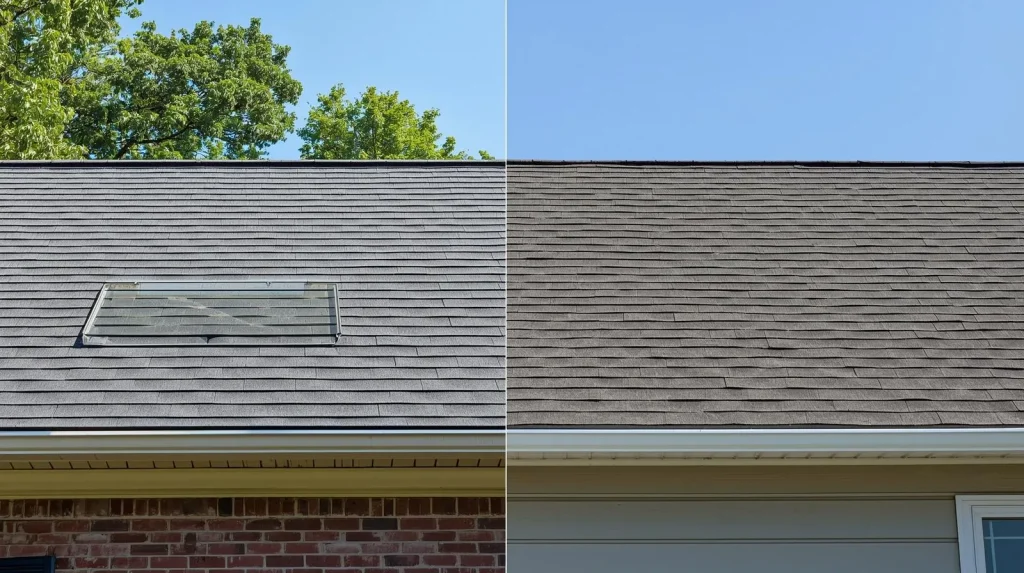
The distinction between repair and replacement isn’t always black and white, but there are clear guidelines I use to help homeowners make informed decisions. Roof repair typically addresses specific, localized issues—shingles that have blown off or been damaged by storms, nail pops where the structure has shifted, pipe boot deterioration, or flashing problems around chimneys and valleys.
Replacement becomes necessary when the roof has reached the end of its functional life or when damage is so extensive that repairs would only serve as expensive band-aids. My general rule of thumb: once a residential roof hits the 10 to 12-year mark, you should start thinking seriously about replacement rather than continuing to pour money into repairs.
Here’s where the math becomes critical. Residential repairs start at around $300 for the simplest fixes, while commercial repairs begin at approximately $700. If I’m returning to your property multiple times per year for repairs, those costs compound quickly. Consider a scenario where repairs cost $600 to $1,000 annually. By year two, you’ve spent $2,000. By year five, you’re looking at $5,000—nearly half the cost of a full replacement for many homes.
I’ll give you a real example from a commercial property I worked on. I kept repairing it—each repair on a commercial roof, the cheapest you’ll ever find is like $700. I went out there maybe four or five times within a year. That’s $4,000 or $5,000 right there. Eventually the landlord got sick of it. It wasn’t me—it’s just that the roof was deteriorating. There’s a shelf life to every roof, and once that life is up, you’ve got to make a decision.

Understanding Your Roof's Lifespan: The Foundation of Smart Decision-Making
Before we dive into the repair-versus-replacement debate, you need to understand what you’re working with. In our Georgia climate, residential roofs typically last anywhere from 12 to 25 years, depending on the quality of shingles and installation. Commercial roofs have a wider range—15 to 40 years—based on the materials used.
This lifespan reality is something many Duluth homeowners don’t factor into their long-term financial planning. Unlike a water heater, which might cost $1,500 to replace every 10 to 15 years, a roof replacement represents a significantly larger investment. A typical townhouse roof in our area runs around $7,000 to $8,000. An average single-family home will cost approximately $12,000 to $15,000. And for those living in upscale subdivisions like St. Marlow, Sugarloaf Country Club, St. Ives, or River Club, roof replacements can soar to $40,000 or even $80,000.
Most homeowners don’t save up, but they need to. You’ve got to plan ahead, just like your car. If your car has 80,000 miles, you know you’ve got another 20,000 to 50,000 miles before you need to save $10,000 as a down payment. It’s the same concept with your roof.
Common Repair Issues I See in the Duluth Area
Georgia’s climate creates specific challenges for roofing systems. The intense sun, summer storms, and local wildlife all contribute to wear and damage that can often be addressed through targeted repairs rather than full replacement.
Pipe Boots and Ventilation Components
Perhaps the most common issue I deal with involves pipe boots—the rubber or plastic seals around plumbing vent pipes that protrude through the roof. The Georgia sun eats these up within 8 to 15 years, causing them to crack and allow water infiltration. Similarly, box vents and ridge vents, whether made of plastic or aluminum, can crack over time or be damaged by wildlife. These are typically straightforward repairs that don’t necessitate a full roof replacement.
Wildlife Damage
Squirrels, raccoons, and birds frequently cause roof damage in our area. They chew through ridge vents, create holes in vulnerable areas, and can compromise the roof’s integrity in localized spots. When caught early, this type of damage is usually repairable. Pests common to the Georgia Piedmont
Nail Pops and Flashing Issues
As homes settle over time, nail pops become common—nails that work their way up through the shingles, creating potential leak points. Flashing issues around chimneys, sidewalls, and valleys are another frequent repair item. Toeboard holes from original construction—where siding installers placed nails and didn’t properly seal them—also fall into this repairable category.
One unusual but not uncommon issue I see: bullet holes. I get calls about bullets probably two or three times a year. People shoot guns up in the air, and they come down and hit the house.
The Insurance Factor: Understanding Your Coverage
Insurance plays a significant role in the repair-versus-replacement equation, particularly in storm-prone Georgia. About 60% of the roofing work I do is covered by insurance claims when storm damage is present. However, homeowners often misunderstand how this process works.
When a roof sustains legitimate storm damage—from wind, hail, or fallen trees—homeowners insurance typically covers the cost of repair or replacement. But there’s an important caveat: if your roof is simply old and worn out without storm damage, filing a claim won’t help and could actually hurt you. It’s like getting a speeding ticket—it’s like a claim on your driving record. Insurance sees that, and they might kick you out or raise your rates.
Understanding the mathematics of insurance is also illuminating. If you’re paying $200 monthly for homeowner’s insurance, that’s $2,400 per year. Over a roof’s 15-year lifespan, you’ve paid $36,000 in premiums. In essence, you’re financing your roof through your insurance payments over time—which is exactly how the system is designed to work when legitimate claims arise.
HOA Considerations: When Repair Isn't an Option
For Duluth homeowners in HOA-governed communities, the repair-versus-replacement decision may not be entirely in your hands. Strict HOAs, particularly in upscale subdivisions with homes valued over a million dollars, often won’t allow visible repairs to remain in place for extended periods.
When you have houses that are over a million dollars, those subdivisions will not let you repair it after six months because it starts getting discolored. New shingles simply don’t match weathered ones, and the aesthetic standards of luxury communities often mandate full replacement even when a repair might otherwise suffice. This is an important consideration for homeowners in communities like St. Marlow, Sugarloaf Country Club, or River Club when budgeting for roofing work.
The DIY Trap: Why Amateur Repairs Often Backfire
In an effort to save money, some homeowners attempt DIY roof repairs or hire handymen without roofing expertise. I’ll be honest with you—this approach almost always makes the problem worse and more expensive to fix properly.
I see it all the time. Homeowners try to fix it themselves, or they hire a handyman, and it just makes things worse. Let’s say you spent $100 on a coating at Home Depot. I come out there—instead of a $400 repair, it’s going to be a $600 repair because I’ve got to tear all that stuff off first and then do the actual repair. So it costs more just for the demolition.
The hidden danger extends beyond immediate costs. Amateur repairs often mask the underlying problem while allowing water damage to continue beneath the surface. You think it’s repaired, but the wood underneath the shingle keeps getting damaged. So that simple $400 repair could cost you $800 three years later because you don’t know the wood’s still rotting until we go in and fix it properly.
It’s like hiring a handyman to do electrical work—that’s dangerous. Roofing requires specialized knowledge and proper technique to ensure repairs actually solve the problem rather than postponing and amplifying it.
One unusual but not uncommon issue: bullet holes. “I get bullets probably two or three times a year,” the contractor notes. “People shoot guns up in the air, and it hits the house.”

What to Expect: How I Evaluate Your Roof
When I come out to evaluate your roof, I’ll typically climb up for a direct inspection and ask about the roof’s history—specifically when it was last replaced. I can usually tell the condition just by looking at it. Based on this assessment, I’ll categorize the roof’s condition as good, fair, or poor and give you a realistic timeframe for how much life remains.
If it’s in fair condition, I’ll tell you that you have about three to five years left. No storm damage means I’ll advise you to start saving—maybe $10,000 or $12,000 depending on your home. Unless a storm hits and you get lucky with an insurance claim, you’re going to need that money for your roof.
I believe in giving honest assessments—even when it means advising against immediate work. I’ll weigh the options alongside you: the cost of ongoing repairs versus the investment in replacement, the remaining lifespan of your current roof, and the financial reality of your situation. If you don’t have the money right now, I’ll keep repairing it, but I’ll also be straight with you about what that means long-term.
When a roof sustains legitimate storm damage—from wind, hail, or fallen trees—homeowners insurance typically covers the cost of repair or replacement. But there’s an important caveat: if your roof is simply old and worn out without storm damage, filing a claim won’t help and could actually hurt you. “It’s like getting a speeding ticket,” the contractor explains. “It’s like a claim on your driving record. Insurance sees that, and they might kick you out or raise your rates.”
Understanding the mathematics of insurance is also illuminating. If you’re paying $200 monthly for homeowner’s insurance, that’s $2,400 per year. Over a roof’s 15-year lifespan, you’ve paid $36,000 in premiums. In essence, you’re financing your roof through your insurance payments over time—which is exactly how the system is designed to work when legitimate claims arise.
One unusual but not uncommon issue: bullet holes. “I get bullets probably two or three times a year,” the contractor notes. “People shoot guns up in the air, and it hits the house.”

Key Takeaways for Duluth Homeowners
Deciding between roof repair and replacement depends on the roof’s condition, remaining lifespan, and your finances.
Key points:
- Financial Planning: Budget for future replacement (typically $12k–$15k for an average home, $7k–$8k for townhomes, up to $80k for luxury homes).
- Repairs: Cost-effective for localized issues (pipe boots, flashing, minor damage) if the roof is otherwise healthy. However, frequent repairs may signal the need for replacement soon.
- Insurance: Storm damage may qualify for coverage; filing a non-storm claim can backfire. We can help assess this.
- Avoid DIY: Amateur repairs often lead to more costly fixes later and hide damage.
- HOA: Strict HOAs may mandate replacement over long-term repairs.
About the Author
John O
John O, the owner of Corus Roofing, brings nearly four decades of construction experience and close to two decades specializing in roofing across the metro Atlanta area. He handles both residential and commercial projects, from storm damage repairs to full replacements, with approximately 60% of his work involving insurance claims.
More Articles Like this
Insurance Denied Your Roof Claim in Duluth, GA? Here’s What You Need to Know
Insurance Denied Your Roof Claim in Duluth, GA? Here’s What You Need to Know Facebook Instagram TL;DR: If your roof insurance claim was denied in Duluth or Gwinnett County, it’s usually because there wasn’t enough documented storm damage, the claim was filed at the wrong time, or the policy only covers repairs—not
Roof Repair vs. Roof Replacement in Duluth, GA: Costs, Timeline & What to Expect
Roof Repair vs. Roof Replacement in Duluth, GA: Costs, Timeline & What to Expect Facebook Instagram TL;DR: When deciding between roof repair vs. roof replacement, know that repairs work for localized issues like nail pops or pipe boots, but multiple annual repairs can cost half a replacement within a few years. Plan ahead—Duluth-area roofs
Service Area
Areas We Serve Roofing Services in Metro Atlanta: Trusted Solutions for Local Homes and Businesses Corus Roofing proudly serves Metro Atlanta with reliable, long-lasting roofing solutions tailored to Georgia’s unique climate. From routine roof repairs to full installations, we bring decades of experience and a dedication to doing things right.